


2.12.2025
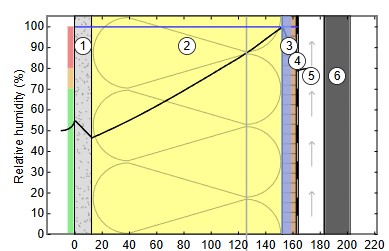
Why Insulation Location Matters in Passive House Design: Keeping the Dew Point Exactly Where It Belongs
One of the defining features of Passive House construction is its razor-sharp focus on building envelope performance. Airtightness, thermal continuity, and moisture control all work together to create buildings that are not only energy-efficient but also comfortable, healthy, and incredibly durable.
Among these details, one topic often hides in plain sight: the placement of insulation and how it affects dew point location within the exterior envelope.
For Passive Houses, getting this right isn’t optional, it’s foundational. Let’s explore why.
What Is the Dew Point, and Why Passive House Cares So Much About It
The dewpoint is the temperature at which moisture in the air condenses into liquid water. Inside a wall assembly, this becomes a critical factor. If warm, moist air travels through the envelope and hits a cold layer, condensation can form within sheathing or structure, leading to mold, rot, poor indoor air quality, and long-term structural damage.
Because Passive Houses rely on extremely airtight and highly insulated envelopes, they must be engineered to ensure moisture safely moves out of assemblies, not into them.
That’s where insulation location comes into play.
Why Exterior Insulation Is Essential in Passive House Construction
Passive House assemblies aim to maintain the entire structural layer within the warm side of the building envelope. The best way to achieve this? Exterior continuous insulation.
Here’s why it’s so important:
1. It Keeps the Dew Point Out of the Structure
Exterior insulation warms the sheathing and framing, preventing temperatures from dropping low enough for condensation to occur. This is especially important in cold climates, where exterior surfaces frequently reach freezing.
2. It Eliminates Thermal Bridging
Passive House certification demands strict control of heat loss. Continuous exterior insulation wraps the building like a blanket, reducing conductive heat paths through studs, rim joists, and other elements. This stabilizes temperatures across the assembly, reducing dew point risk.
3. It Protects the Airtight Layer
Most Passive House projects position the airtight layer at the structural sheathing or interior membrane. Keeping this layer warm prevents moisture accumulation and improves long-term performance.
4. It Enhances Durability by Allowing Assemblies to Dry
With the dew point safely in the exterior layer, typically within the continuous insulation, any minor moisture that does make its way into the assembly can dry outward more readily.
The Passive House Rule of Thumb: Keep the Sheathing Warm
In atypical code-built home, insulation is often placed entirely in the stud cavity. This leaves the sheathing exposed to winter temperatures, increasing the risk of interior condensation.
Passive House flips that logic:
· The sheathing (and structure) must stay above the dew point temperature.
· Exterior insulation must be thick enough to keep the assembly “warm” relative to interior humidity levels.
· Climate-specific ratios of exterior to interior insulation ensure predictable moisture performance.
Depending on your climate zone, Passive House models often require substantially more exterior insulation than conventional construction, sometimes 50–70% of the total R-value.
Hybrid Passive House Assemblies: When Both Interior and Exterior Insulation Are Used
Some projects use a mix of exterior continuous insulation and interior service-cavity insulation. This is acceptable, provided the exterior insulation remains dominant and is thick enough to maintain proper dew point control.
Tools like WUFI, PHPP, or local Passive House guidelines help determine the correct ratios.
Real-World Issues When Dew Point Control Is Poor
Even in airtight, well-insulated structures, incorrect dew point placement can cause:
1. Condensation on the cold side of sheathing
2. Mold hidden behind membranes
3. Frost accumulation within walls during winter
4. Diminished insulation performance
5. Long-term rot or structural deterioration
Passive Houses must avoid these conditions not only for durability, but to maintain indoor air quality and certification standards.
Moisture-Smart Passive House Design Principles
To ensure the dew point stays exactly where it should, Passive House designers rely on:
1.Exterior continuous insulation
The most reliable method is to keep assemblies warm and condensation-free.
2.Extremely airtight construction
Air leakage is the main driver of moisture through walls. Passive House standards (≤0.6ACH50) drastically reduce this risk.
3.Thoughtful placement of vapour control layers
Variable-perm membranes or smart vapour retarders help assemblies dry in the correct direction.
4.Careful modeling of assemblies
Software like PHPP and WUFI confirms that heat and moisture behave as expected.
5.Climate-specific detailing
What works in Vancouver is not what works in Winnipeg. Dew point control must account for local temperature, humidity, and precipitation patterns.
Conclusion: Insulation Location Isn’t Just a Detail. It’s a Passive House Essential
In Passive House construction, insulation does far more than improve energy efficiency. It shapes how heat, air, and moisture interact within the building envelope.
By placing insulation correctly, primarily on the exterior, and ensuring that the dewpoint lands safely within a stable, non-structural layer, Passive House projects achieve:
· superior durability
· exceptional indoor air quality
· minimal maintenance needs
· consistent comfort
· ultra-low energy demand
A Passive House performs beautifully because every detail matters, and insulation placement is one of the most important details of all.


