


16.3.2026
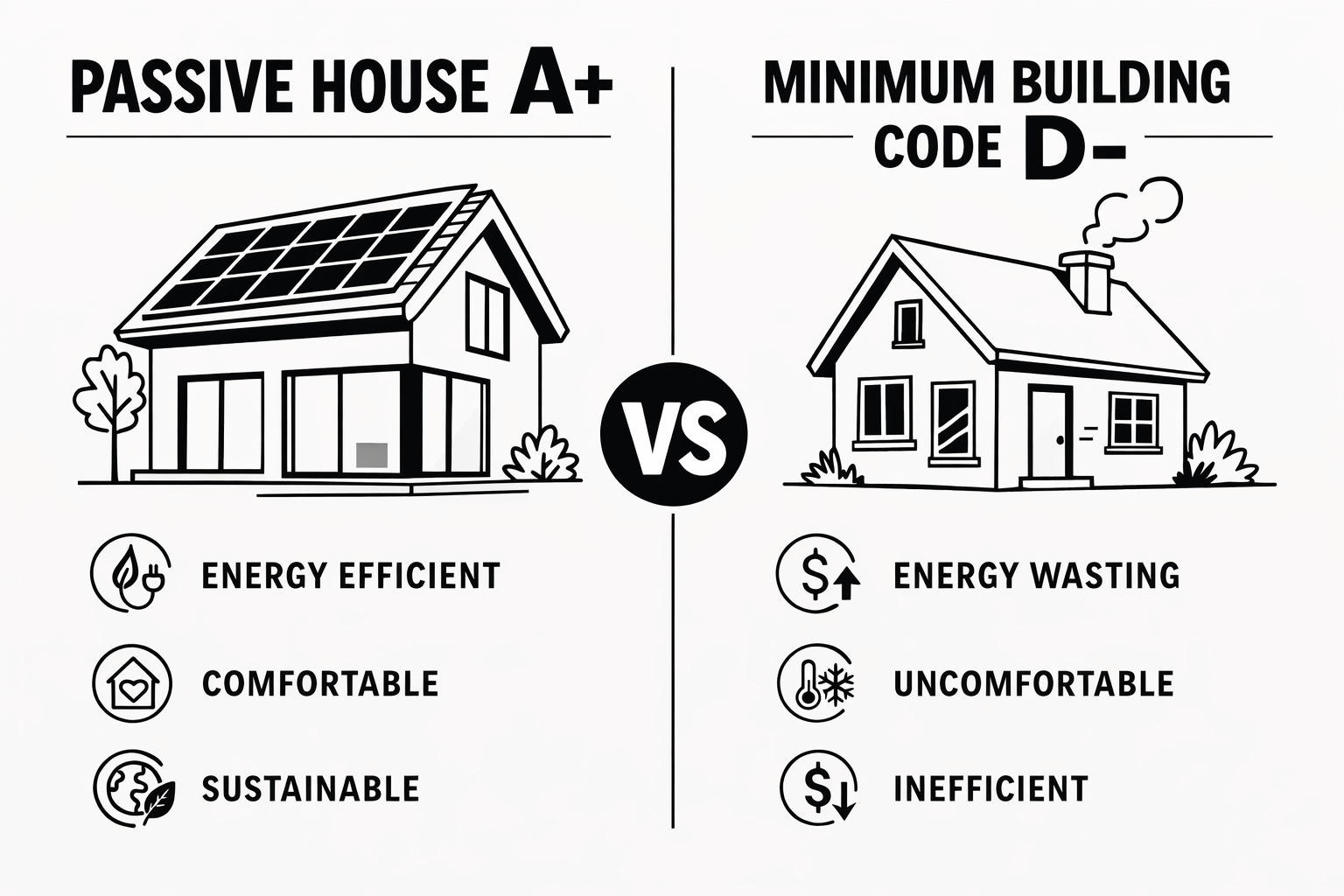
From D- to A+: Grading the Performance of the Homes We Build
When we think about grading performance, most people immediately understand the concept of a report card. An A+ represents excellence, while a D- suggests the bare minimum needed to pass. The same concept can be applied to residential construction. If we graded homes based on energy performance, comfort, durability, and long-term value, minimum building code construction would sit near the bottom of the scale, while Passive House would clearly earn the A+.
The D-: Minimum Building Code
Minimum building code construction represents the lowest acceptable legal standard for building a home. Building codes are designed primarily to ensure life safety and basic structural integrity, not optimal performance. A code-built home may meet insulation minimums, include standard windows, and rely on conventional heating systems, but it often still suffers from air leakage, temperature fluctuations, and higher energy consumption.
In grading terms, this is a D- level of performance. The home technically passes, but it does little to optimize comfort, energy efficiency, or long-term operating costs. Homeowners often compensate with larger mechanical systems, higher utility bills, and ongoing maintenance issues caused by uncontrolled air and moisture movement.
The C and B Range: Better Than Code
Moving up the scale, many builders aim for homes that perform better than minimum code. These homes might include improved insulation levels, better windows, tighter air barriers, or more efficient HVAC systems. Programs such as ENERGY STAR or advanced building practices can elevate a home into the C+ or B range, delivering noticeable improvements in comfort and energy consumption.
While these homes perform better, they are often incremental improvements rather than a complete performance strategy. Mechanical systems still carry much of the load, and the building enclosure may not be optimized to minimize energy demand.
The A Range: High-Performance Construction
Homes that reach the A range are intentionally designed to prioritize building science principles. These projects emphasize airtight construction, continuous insulation, reduced thermal bridging, and high-performance windows. Mechanical systems become smaller and more efficient because the building itself is doing much more of the work.
At this level, homeowners experience consistent indoor temperatures, improved indoor air quality, and significantly reduced energy bills. However, even within the A range there is still one standard that consistently rises above the rest.
The A+: Passive House
At the top of the grading scale sits Passive House, widely recognized as the gold standard of high-performance building. Passive House takes a rigorous, science-based approach to designing buildings that dramatically reduce energy demand while maximizing comfort and durability.
Passive House buildings achieve this through five core principles:
The result is a home that uses up to 80–90% less heating and cooling energy than conventional buildings, while providing unmatched thermal comfort and healthy indoor air quality. Instead of relying on oversized mechanical equipment, Passive House design reduces the need for energy in the first place.
Why the Grading Matters
Just as in school, a passing grade does not always represent excellence. Minimum code construction may meet legal requirements, but it leaves significant opportunities for improvement. By shifting the industry’s mindset from “meeting code” to “achieving performance,” we can build homes that are healthier, more comfortable, and dramatically more efficient.
The grading scale is simple:
As homeowners, builders, and designers look toward the future of construction, the goal should not simply be to pass the test, but to earn the A+.


